Every Parent Wants the Best — But Are You Helping or Pressuring?
When it comes to career decisions, every parent has one goal: to see their child succeed. But in trying to help, many parents unknowingly create pressure that does more harm than good.
The truth is — career support and career pressure are very different things.
This blog is for parents who want to genuinely support their child's career journey — not control it.
Why Parents Are the Most Powerful Career Influence
Research consistently shows that parents are the single biggest influence on a child's career decisions — more than teachers, friends, or social media.
This is both a responsibility and a risk.
Supportive parental involvement looks like:
- Exposing your child to diverse career options
- Encouraging exploration and curiosity
- Listening without judgment
- Supporting their interests even when they differ from yours
Pressure-based involvement looks like:
- Insisting on specific careers (doctor, engineer, CA)
- Comparing your child to peers or cousins
- Dismissing interests that don't match your expectations
- Making career decisions on their behalf
The difference between the two can shape your child's confidence, satisfaction, and long-term success. ## 5 Ways Parents Can Genuinely Support Their Child's Career Journey
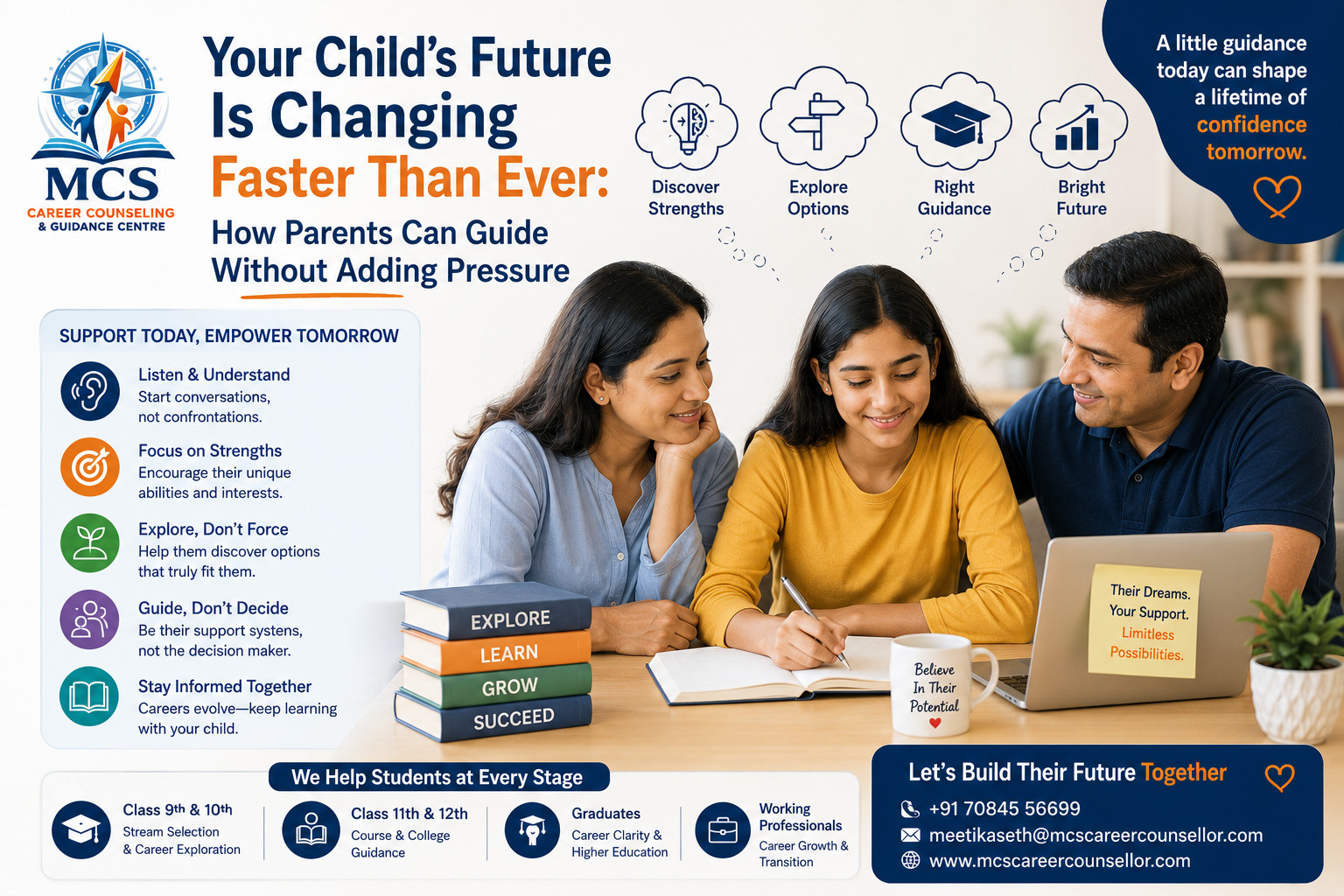
1. Listen First — Advise Later
Before sharing your opinion, ask open-ended questions:
- "What subjects do you enjoy most?"
- "What kind of work do you imagine yourself doing?" - "What problems do you want to solve in the world?"
When children feel heard, they are far more open to guidance. Listening builds trust — and trust opens doors.
2. Separate Your Dreams from Their Reality
Many parents unconsciously project their own unfulfilled ambitions onto their children. If you always wanted to be a doctor but couldn't, be careful not to push that dream onto your child.
Your child is a separate individual with their own aptitudes, interests, and life path.
> Their career is not a second chance for yours.
3. Update Your Career Knowledge
The career landscape has changed dramatically. Many high-paying, respected careers didn't exist 20 years ago. Before dismissing a career option, research it.
- Game design is a multi-billion dollar global industry
- Content creation can generate crore-level incomes
- Data science, UI/UX, cybersecurity, digital marketing — these are among the fastest-growing fields today
- Environmental science and sustainability careers are booming globally
Outdated information leads to outdated advice. Stay curious alongside your child.
4. Invest in Professional Career Guidance
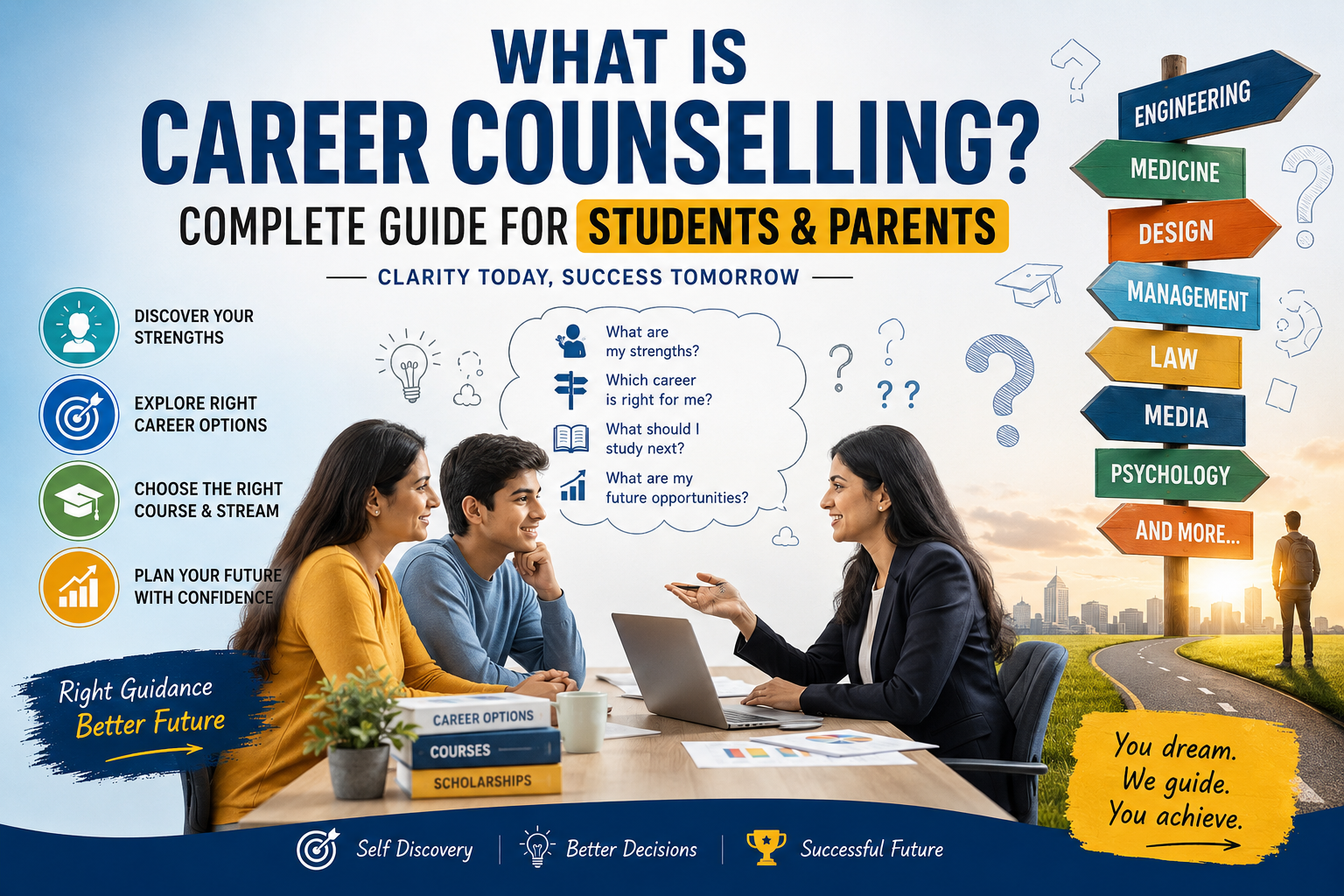
A career counsellor provides objective, evidence-based guidance that neither parents nor teachers can fully provide.
Psychometric assessments reveal aptitudes, interests, and personality traits that even the student may not be fully aware of. A professional counsellor helps translate these insights into a clear career direction.
Think of career counselling as an investment — the cost of a few sessions is negligible compared to the cost of a wrong career choice.
At MCS Career Counselling & Guidance Centre, we work with both students and parents together — so everyone is aligned, informed, and moving in the same direction.
5. Trust the Process — and Trust Your Child
Career clarity rarely comes overnight. Allow your child time to explore, ask questions, and even change their mind.
Premature certainty is often a sign of external pressure — not genuine self-knowledge.
Children who feel supported in their career choices develop greater confidence, resilience, and long-term career satisfaction.
Children who feel pressured often comply in the short term but experience regret, burnout, or career changes in their late 20s or 30s.
What to Do When You Disagree With Your Child's Career Choice Disagreements are normal. Here's how to handle them constructively:
1. Acknowledge their perspective first — "I understand why you're drawn to this" 2. Share your concerns without ultimatums — "I'm worried about job security here — can we research it together?"
3. Seek a third-party perspective — A career counsellor can mediate and provide objective data
4. Agree on a timeline — "Let's explore this for 3–6 months and then reassess"
5. Respect their autonomy — Ultimately, it is their career and their life
The Role of Emotional Support in Career Decisions
Career confusion is normal — especially in today's fast-changing world. Students often feel overwhelmed, anxious, and unsure.
As a parent, your emotional support matters more than you realise.
You can help by:
- Normalising uncertainty — "It's okay not to have all the answers right now"
- Avoiding panic reactions when they express confusion
- Encouraging reflection rather than rushing to a decision
- Celebrating small steps of clarity and progress
A child who feels emotionally safe at home is far more likely to make thoughtful, grounded career decisions.
When Should You Involve a Career Counsellor?
Consider professional career counselling when:
- Your child is approaching Class 10 stream selection
- They are confused or anxious about career choices
- There is conflict at home about career direction
- Your child seems disengaged or unmotivated in studies
- They are approaching Class 12 or graduation and need clarity
Early guidance saves time, money, and emotional stress — for both students and parents.
Conclusion: Your Role Is to Create Conditions, Not Control Outcomes
Your role as a parent is not to choose your child's career — it is to create the conditions in which they can discover it for themselves.
Listen more. Advise less. Stay curious. Invest in professional guidance. And trust your child's capacity to find their own path — with your support behind them every step of the way.
At MCS Career Counselling & Guidance Centre, we help students and parents navigate career decisions together — with clarity, confidence, and no pressure.
Book a session today and take the first step toward a clearer future.
Frequently Asked Questions (FAQs)
Q1. At what age should parents start thinking about career guidance for their child?
Ideally, career awareness can begin as early as Class 8 or 9. Formal career counselling is most impactful before stream selection in Class 10, and again after Class 12.
Q2. My child wants to pursue a non-traditional career. How should I respond?
Take the interest seriously. Research the field together — understand the career trajectory, required skills, and earning potential. Many unconventional careers today are highly respected and financially rewarding. Keep communication open.
Q3. How is career counselling different from what parents already do?
Career counsellors use scientific psychometric assessments and have deep knowledge of modern career options, industry trends, and educational pathways. They provide objective, personalised guidance — free from the emotional biases that naturally come with parenting.
Q4. What if my child refuses to go for career counselling?
Start by having an open, non-pressured conversation about it. Frame it as an opportunity to understand themselves better — not as a sign that something is wrong. Many students become enthusiastic once they experience the process.
Q5. Can career counselling help reduce conflict between parents and children about career choices?
Yes. A career counsellor creates a neutral space where both students and parents can express their perspectives, understand each other better, and arrive at decisions collaboratively — reducing conflict and building trust.